
Electromobility is currently a much-used and, above all, much-discussed term.
But let's be honest: what does it actually mean? What exactly are we talking about when we use the term electromobility? And what is it all about anyway?
If you want to take a closer look at the topic, you should start with the basics.
Contents
Electromobility - what does it actually mean? What electric vehicles are there? Is it all just hype or is it here to stay? E-mobility: not yet perfect - but an important step!Electromobility - what does it actually mean?
Put simply, electromobility, also known as e-mobility, describes any form of transport using an electric drive.The second part of the term mobility refers to the ability to move from one place to another. The word element electro- describes the method of locomotion.
According to the BMWK, the German government defines electromobility as follows:

So if you use the term electromobility, you are talking about electric locomotion. In today's context, this primarily refers to electrically powered means of transport.
And why do we need electromobility? Why do we need an alternative? The way we have been using internal combustion engines to get around works.
It's like this: Generating energy from electricity is considered to be significantly lower in emissions and therefore more environmentally friendly. It is intended to replace conventionally used fuels and thus contribute to protecting our climate.
In connection with the Electric Mobility Act passed in 2015, electromobility therefore serves as a generic term for a more sustainable and lower-emission organisation of the mobility sector.
Ideally, the entire transport network should be e-mobilised in the future.
What electric vehicles are available?
Electromobility therefore refers to all vehicles that are characterised by an electric drive.
Nowadays, people often think of electric cars first. But also
- E-bicycles (e-bikes or pedelecs)
- E-motorcycles
- E-buses
- E-trucks
- E-scooters
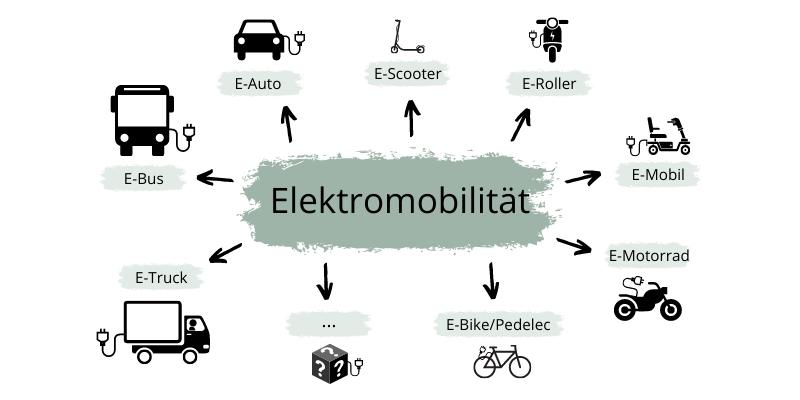
In the automotive industry, a further distinction is made within the category of electromobility between
- purely battery-powered vehicles (BEV),
- battery-powered vehicles with range extenders (REEV),
- Hybrid (battery charging by combustion engine)
- Plug-in hybrid (battery charging with drive motor and externally via the power grid)
In contrast, e-motorcycles, e-mobiles and e-scooters are largely powered purely by electricity. Hybrid solutions tend to be the exception here.
Is it all just hype or here to stay?
A legitimate question, considering that social demand for alternative means of transport is growing all the time.
But critical voices are also becoming louder.
In this context, critics often express justified concerns about the long-term viability of e-alternatives as well as doubts about the positive effects on the climate.
Although e-vehicles do not emit any exhaust gases, electrically powered vehicles continue to produce CO2 in their value chain.
In addition, the electricity used to power them cannot yet be generated entirely from renewable energy sources .
It is therefore not possible to speak of a completely CO2-free alternative.
However, these arguments against an electromobility transition are mainly voiced in relation to electric cars.
According to a BMDV study on mobility in Germany, we only use our cars for an average of around 30 kilometres per day.
E-scooters now have ranges of up to 100 km (which easily covers the average 30 km per day). They emit no exhaust fumes, are quiet, low-wear, have low operating and maintenance costs and finding a parking space is also much easier (practical, especially for all city kids).

In addition, you can choose your own energy source, as most e-scooter models can be charged at a standard household socket. So if you get your electricity from renewable green energy, you can charge your e-scooter CO2-free.
In contrast to e-cars, you are completely independent of publicly accessible charging points.
If you want to contribute as little as possible to CO2 pollution but still want to stay mobile, an e-scooter can be a sensible alternative to a conventional petrol car. Especially in urban traffic or for short distances (the so-called last mile).
But back to the original question: is electromobility just hype?
As always, there are arguments for and against an e-mobility turnaround. Arguments on both sides are entirely justified. And there is no talk of a perfect technology that alone can save our world.
Nevertheless, e-mobility can make a major andimportant contribution to protecting our climate. Even if the current problems still need to be overcome, it is a first step in the right direction. Over time, the aforementioned negative aspects of electromobility can be improved with continuous development and research.
When we at Rolektro launched the first e-scooter models on the market back in 2005, we were one of the few manufacturers of this e-alternative.
The expansion of a nationwide service network with partner workshops proved difficult at the beginning, as the belief in this mobility alternative was not yet strong enough. There was talk of unprofitable hype.
And now, 17 years later, we are constantly developing new models for a wide range of needs and are constantly expanding our partner network - and other providers have also recognised the potential .
And there is no end in sight. We are all constantly developing ourselves and our e-scooters.
We at Rolektro therefore believe that the hype is long gone and that electromobility is here to stay.
E-mobility is a long-term concept that will remain successful through constant further development.
In the private sector in particular, in addition to e-cars, alternatives such as e-bikes, e-motorbikes and e-scooters make sense in the long term to cover short distances and leave the car at home more and more often.
E-mobility: not yet perfect - but an important step!
Electromobility is an alternative form of transport that can provide promising support in the fight against climate change.
Of course, the technologies are still far from being fully developed and there are still some difficulties that need to be overcome.
However, we are only at the beginning of this transition and now have the opportunity to improve and further develop existing technologies.
Therefore, the turnaround is certainly an important first step in the right direction!
What do you think? Is it all just hype or the beginning of a promising change?

This is the first article in our blog series The e-scooter 1x1 - #rolektroerklärt
You can come across a lot of information, technical terms, opinions and myths when researching e-mobility. With this series, we therefore want to provide a simple introduction.
Our focus is on electric mobility scooters, as we have the relevant expertise thanks to our diverse product range (e-scooters, e-scooters, scooters for the elderly and much more) andyears of experience.
We also regularly cover topics that are of particular interest to many e-scooter newcomers (but certainly also enthusiastic e-scooter professionals) and provide answers to questions about the e-alternative.
To ensure that no questions remain unanswered at the end of this series, we look forward to your feedback in the comments! What topics are you interested in?
Was this article helpful?
We would be delighted if you share this article with family, friends and acquaintances. Help us to make electric mobility possible for everyone!